
By Chuck Haviland
The first one cent coin struck at a private mint for the United States, was the Fugio Cent. In 1797. At the time Paul Revere was a noted blacksmith, he may have been involved with providing smelting services for the new government. The Fugio Cent was almost 5 times heavier and 50% larger than its modern coin. Its composition was 100% copper.

In 1856 the first small cent was produced, predominately for the collector and to show the public what the new cent would look like. It was called the Flying eagle cent. It’s composition was 88 % copper, with a diameter of 19 mm. This was to become the standard. In essence the flying cent was to become a 2 year coin (1857 & 1858).From 1859 to 1909 the cent utilized the profile of an Indian head on the front side of the coin. Its composition and size remained the same as the flying cent. Today the Indian head cent holds a price of $50 to $400, if in an EF-40 condition. Except for some error coins and the 1877 penny which had a mintage figure of approximately 852,500 coins. The 1877 penny in an EF-40 condition can often command a price of $2500 per coin. The only indian head coin with a similar mintage number was 1909 whose mintage was approximately 309,000 and a value of $825 in an EF-40 condition.

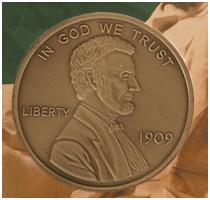
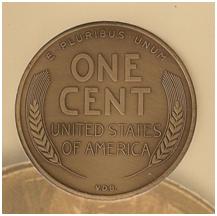
The Lincoln wheat ears cent was minted from 1909 to 1958. Its remarkable in light of the fact that Victor D. Brenner (the current chief engraver) was permitted to have his initials on the 1909 VDB penny and the rarer 1909-s VDB penny. The values for these early wheat cents remain quite high. For coins in an EF-40 condition the 1909-s (the s mint coins consistently draw a higher price) is valued at $1,400, the 1910-s is valued at $45, the 1911-s is valued at $85, the 1912-s is valued at $70, this trend continued until 1917.
In 1943 there was a need to conserve copper due to WWII, so the US Mint made penny’s from steel. This lasted for just one year, 1943.
In 1959 the US mint changed the reverse side of the penny to celebrate the 150th anniversary Lincoln’s birth, changing the reverse from the wheat ears design to show the Lincoln memorial.
Then in 1960 they made a large and small date coins from both mints. In 1970 the mint made two 1970-s penny’s. One with a small date and one with a large date.
Then in 1982 the US mint made 7 different penny’s, from 95% copper and 5% zinc they made a Philadelphia large and small date coin and a Denver large date coin. From 97.6% zinc and 2.4 % copper coating they made a Denver large and small date coin and a Philadelphia large and small date coin.
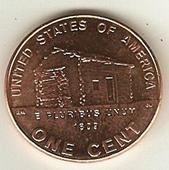
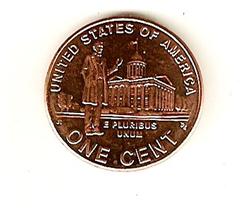
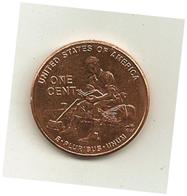
Then in 2009 the government made 4 distinctly new penny’s for that year only. The changes were all on the reverse and from all three mints. The first to appear was the log cabin, signifying Lincolns’ birth and early childhood. The second penny was of Lincoln splitting a log rail. The third coin was of Lincoln going to congress and the 4th coin was of the congressional building.
Since 2010 the Lincoln penny has illustrated a shield on its reverse side.

 Pierce Prairie Post