
Unincorporated Pierce County has always been a difficult government to navigate. Now that planning and government has become computerized, the virtual environment is even more challenging to follow.
Here is a brief, but hopefully helpful, list for navigating unincorporated Pierce County governance. If you are in another County, the system is going to be a little different.
The County has you mapped, listed, and detailed if you own property. That detail can be located on the PublicGIS (that is Graphic Information System). PublicGIS is used to map an incredible amount of data from parcel number, property tax and building information to the tax rates, flood zones, sewer locations and utilities.
It is also important to know which unincorporated community you are located in. Each community has a land use plan that dictates zoning, uses for particular parcels and the boundaries of those uses. When a developer wants to do something outside those limits, they must get a variance from the county which is a process that begins with a group of your neighborhood peers called a LUAC, Land Use Advisory Committee. It is made up of you neighbors approved by County Executive and affirmed by the County Council. From there it goes to the Planning Commission, a Countywide appointed board, and finally to the Hearings Examiner. After that point it is approved unless someone pays to take it into the court system.
So if you see a yellow sign go up on a parcel, you look up the parcel number on the PublicGIS, then you go to Planning and Land Services Online Permits portal. You must agree to the Terms of Use before entering this site. In order to make public comment to a permit application, you must register yourself on the site.

You can see there is a lot of information stored in this system. To trace the progress of a yellow sign that went up, choose Permit Search at the top of the page.

At this point, you enter the permit number or the tax parcel number. If there are multiple parcels, only one of the numbers is going to be used to store the data. You may have to search for the correct one.

From there, you have places that documents are stored as the applicant goes through the permit process. Department Status will give you some data, but Documents usually is a gold mine of information. There you might find letters from Tribes about artifacts, engineering drawings of the planned developments with dimensions of critical components, like how long housing development driveways will be or how many parking stalls for new apartments. You will also see if they were required to pay impact fees for schools or roads.
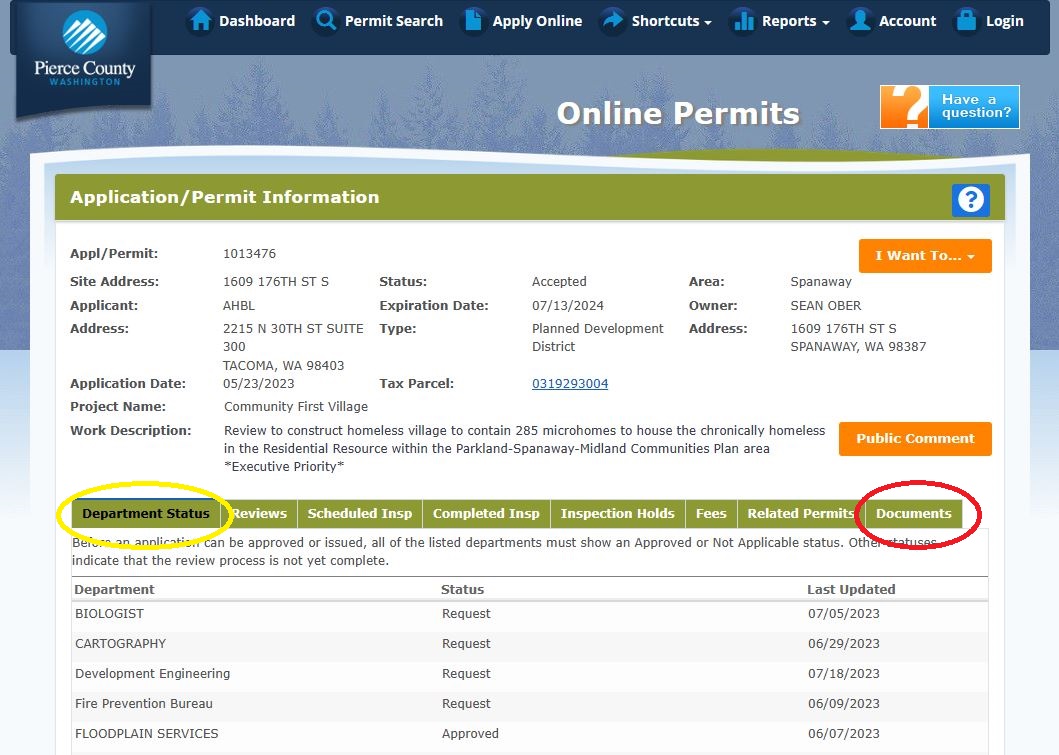
You may also notice above the Documents an orange box titles Public Comment. If there is a SEPA, (State Environmental Policy Act) for environmental impacts to be considered, there definitely will be a public comment period open for you to add input on noise, light, water, wildlife or any other impacts. To comment you must register yourself, but submittal is fairly easy for a Word or PDF document.

But how do you find that first meeting of the LUAC for the affected community? You need a community map. Here are some general maps the County produced. Each plan page has a more detailed map of the location encompassed.

Here are the links to specific area plans in Pierce County. They will each have a map of the area they encompass.
Alderton-McMillan Community Plan
Frederickson Advisory Commission Plan Page
South Hill Advisory Commission Plan Page
Mid-County Land Use Advisory Commission Plan Page
Parkland-Spanaway-Midland Advisory Commission Plan Page
Graham Advisory Commission Plan Page
Upper Nisqually Valley Plan Page
Key Peninsula Advisory Commission Plan Page
Anderson Island Citizens Advisory Board Anderson Ketron Plan Page
Gig Harbor Peninsula Land Use Advisory Commission Plan Page
Brown Pont & Dash Point Community Plan
To affect legislation in the county, you also need to know who your County Council person is.

When you need to create legislation, you are best off with their support. Council positions are partisan. Occasionally, your representative in not in a party likely to support your request. At that point you need to chat with the nearest Council person from the other party. The balance of the Council will determine if what you desire is likely to pass.
If you are in a mode to push back against a proposal brought to the county, whether an ordinance or a resolution, you need to express your opinion and ideas as early in the process as possible. Here is the process:
- An item is placed on the consent agenda. This is a grouped item that simply makes the legislation eligible for a committee hearing. The item will be placed on a committee calendar and you can make public comment at that hearing or directly by calling or emailing your councilmember. Sometimes, individual councilmembers do not share with the whole committee. You are able to send to the group council email or email copy all the council members if your information is important for them all to know.
- After the Committee, the item may go to a rules or budgetary committee for a hearing also before it goes to the full council for passage. That is another chance to get in public comment.
- Full Council. Once a resolution or ordinance goes in front of the full Council for a vote, it probably already has enough Council members on board to pass. At this point, convincing them differently is probably not possible without a miracle or a serious piece of new information. What you testify in front of the full Council is more for show, unless you manage to get 150 people to show up and another 300 to write letters, then you can frighten them into at least tabling the item for further study. Strong voter pushback will impact most elected officials. A change in the Health Department did that in 2017. It was quite a turnout and a very long, late meeting of testimony.
Once every two years, the County Council accepts proposals to change the land use Comprehensive Plan, called Title 18a, Development Regulations. This is a watch list item. Developers like to make sweeping changes that let them do things like create tiny lots with no driveway for parking or change a Rural Residential zoning to Multi Family Housing. That is, building on wetlands. I just noticed a 2017 proposal by developer Chuck Sundsmo for that one. Oh my, he is bold.
Last, but very important is the County Council Calendar. This has links to each meeting, its agenda and a packet full of detail. This is where you can check in advance for what they are legislating on a given day. Occasionally it changes the same day or day before. An example was the recent override of the County Executive’s veto on the RR zoning in the PSM Community Plan that permitted the Tiny Homes. That popped into the schedule the morning of the meeting. Why? Because it took until then to convince Amy Cruver she was going to vote against a member of her party, the County Executive, and with her full tilt voters that opposed that zoning change. But, these miracles do happen.
I hope that helps describe how the system works. Of course, there are many nuances to it. And this was just the County Council, not the state or federal processes. Please feel free to comment on this story. If you think you would like an hour or two of training on active citizenship, please add that to your comments. In addition, I have a link to courses the State of Washington Department of Commenrce is now offering on the topic of citizen participation.
Here is a link to the courses the State of Washington is offering on land use planning.
And the Pierce County Council and Pierce County Executive can be reached at those links.
 Pierce Prairie Post
GREAT ARTICLE! This is exactly what creates effective engagement. Thank you! I am interested in training sessions. 😀