
Adapted from the Department of Ecology Reports.
Link to current Periodic Review for the Frederickson Industrial Park, May 22, 2025. Data here is excerpted from Department of Ecology report. You can find them in their entirety at the DOE web links.
I have the supplemental EIS for the site but am still trying to locate the Original EIS my mother saved, with the data about these waste wells.
-Editor
Historical use
The Columbia Powder Company first developed the site in 1935 to produce explosives. Since
then, property ownership changed many times:
- Columbia Powder Company sold the property to Olin Mathieson Chemical Corporation
(Olin) in 1956. - Olin sold the property to Commercial Solvents Corporation in 1963, which then changed
its name to Mallinckrodt US, LLC (Mallinckrodt).
- Despite changes in ownership, explosives continued to be produced on site until 1976.
Between 1976 and 1986, the site was used for timber cutting, lumber milling, and log
storage. - In 1987 Centrum Properties (Centrum) bought the site. Centrum then developed the site
as an industrial park. - In 1990, Centrum sold the property to the current site owner who developed the site to
make aircraft parts.
Ecology named Mallinckrodt and Olin the potentially liable persons (PLPs) responsible for
cleaning up the site in 1995. Mallinckrodt and Olin are the successors of previous site owners.
In 1997, Ecology entered into an agreed order with the PLPs to complete a second phase of the
remedial investigation/feasibility study (RI/FS). The first phase was completed by Centrum in 1995.
How the site became contaminated
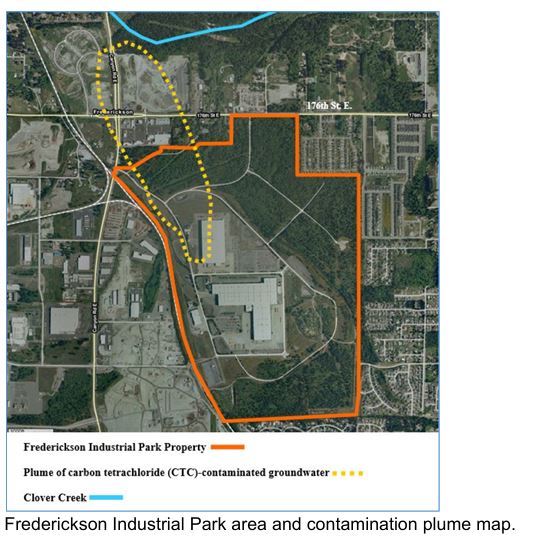
Groundwater at the site is contaminated with carbon tetrachloride (CTC). In 1988, Centrum discovered it at the site while developing the property into an industrial park. In the past, CTC was used as a cleaning solvent or in fire control. CTC can be harmful to human health and the environment, so cleanup is important.
Earlier Site Cleanup
Over the past 25 years, the Potentially Liable Parties (PLPs) and other property owners have
conducted multiple studies and cleanup efforts at the site. These efforts included:
- Studying soil, groundwater, and soil vapor.
- Removing contaminated soil, waste, and debris.
- Treating groundwater.
- Monitoring groundwater quality.
In 1999, testing showed that levels of carbon tetrachloride (CTC) in the area were low enough
that vapor intrusion was not a risk to human health. (Vapor intrusion occurs when chemicals
move from the soil or groundwater into the air inside buildings.)
However, further studies in 2000 found that the contamination had spread to well water
supplies serving nearby homes and businesses. In response, public water service was extended
to the affected area by 2007, ensuring that properties previously using private wells had access
to safe drinking water.
Following these cleanup efforts, groundwater tests showed: - The contaminated area (plume) was shrinking.
- Contamination levels were decreasing.
Because the site was improving naturally, experts proposed allowing the remaining CTC to
break down through a process called natural attenuation. This method uses natural physical,
chemical, and biological processes to reduce contamination over time.
The Washington State Department of Ecology (Ecology) selected natural attenuation as the final
cleanup approach because: - Studies confirmed that CTC levels were steadily decreasing.
- The risk of human exposure to contaminated groundwater was minimal.
- Other cleanup methods would have a larger environmental impact and higher costs.
Public Review and Final Cleanup Plan
Ecology held a public comment period from January 23 to February 24, 2014, to gather
feedback on the proposed cleanup plan. The following documents were available for public
review:
- Agreed Order – A legal agreement requiring Olin Corporation and Mallinckrodt US, LLC
to complete the cleanup. This order included:
o Cleanup Action Plan (CAP) – Outlines the cleanup process.
o Compliance Monitoring Work Plan – Details how, where, and when
groundwater testing will occur.
o Remedial Investigation/Feasibility Study (RI/FS) – Describes the contamination
and evaluates cleanup options.
o Public Participation Plan – Explains how Ecology will keep the public informed
and involved.
No public comments were received during the review period. After finalizing the documents,
cleanup efforts moved forward.
In 2023, Ecology conducted the first periodic site review. The results confirmed that the
cleanup was effective, CTC levels were continuing to decrease, and environmental regulations
were being followed.
2022 Groundwater monitoring results
Eight groundwater monitoring wells were sampled on November 8th, 2022 using PDB sampling
methods (Tables 3 and 4). This event is currently the most recent groundwater sampling event
at the time of this report. All eight samples were analyzed for CTC by ALS Laboratories of Kelso,
WA. CTC was detected in all eight wells at concentrations ranging from 0.17 to 3.0 ug/L. Of
these results, five wells (11-CL, HLA-1, BMW-18, MW-1, and MW-13) exceeded CTC’s MTCA
Method B cleanup level of 0.63 ug/L. CTC concentrations declined in all eight wells indicating
that MNA continues to effectively reduce CTC concentrations in groundwater.
Groundwater elevation data collected on November 8th, 2022, indicates that the shallow
aquifer (Aquifer A) continues to maintain a north-northwest gradient towards Clover Creek
(Table 2; Geosyntec, 2023). This observation is consistent with historical monitoring events at
the Site.
Direct contact
The cleanup actions were intended to eliminate exposure to contaminated groundwater at the
Site. In accordance with the Site’s Covenant, groundwater beneath the Site remains
contaminated and shall not be extracted for any purpose other than temporary construction
dewatering, investigation, monitoring, or remediation. Drilling of a well for any water supply
purpose is strictly prohibited at the Site. The Covenant appears to be successfully restricting
unpermitted use of the Site’s contaminated groundwater. Boeing and other operators at the
Site have frequently and correctly updated Ecology when parcels have been transferred,
ensuring that the environmental covenant has been transferred along with the associated
deed.
Protection of groundwater
During the remedial investigation phase of the cleanup, it was determined that soils in the
potential source areas were not acting as a source for CTC in groundwater. Using the highest
soil gas detections observed in the potential source areas, it was estimated that soil
concentrations of CTC would still be less than the most conservative soil screening levels
available at the time (Geosyntec, 2012). At this time, no known soil remains at the Site with
concentrations greater that the CTC cleanup level.
Conclusions
The cleanup actions completed at the Site appear to be protective of human health and
the environment.
Groundwater compliance monitoring at the Site indicates concentrations of CTC continue
to decline (Table 4, Figure 1).
The Covenant for the property is in place and is effective in protecting human health and
the environment from exposure to hazardous substances and the integrity of the cleanup
action.
Based on this periodic review, Ecology has determined the requirements of the Covenant and
the Pierce County Urban Growth Area well installation restriction is being followed. No
additional cleanup actions are required by the property owner currently. The property owner is
responsible for continuing to inspect and monitor the Site to ensure the integrity of the cleanup
action is maintained and monitored.
 Pierce Prairie Post
Good info, Marianne.
Al
Get Outlook for Androidhttps://aka.ms/AAb9ysg