
From the Washington State Department of Ecology
Drought Response
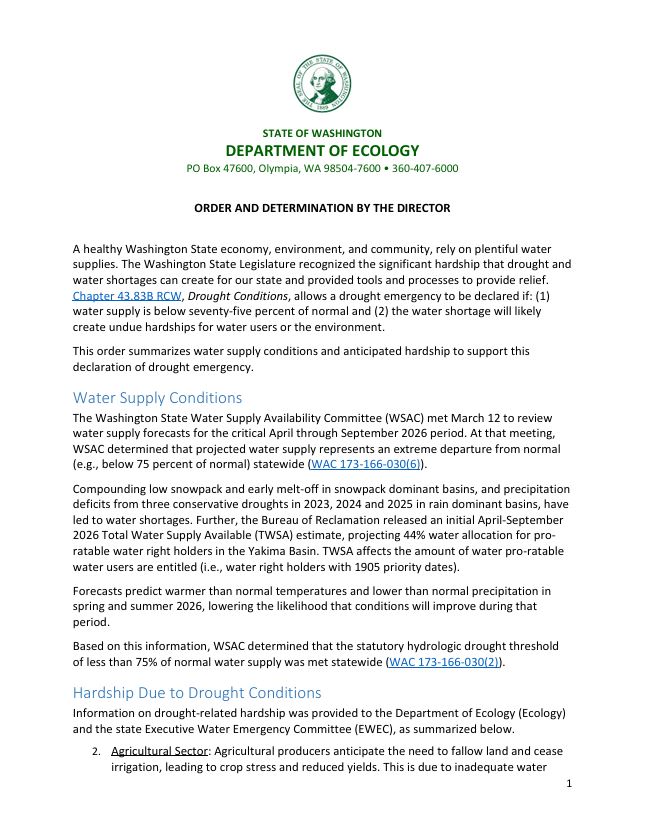
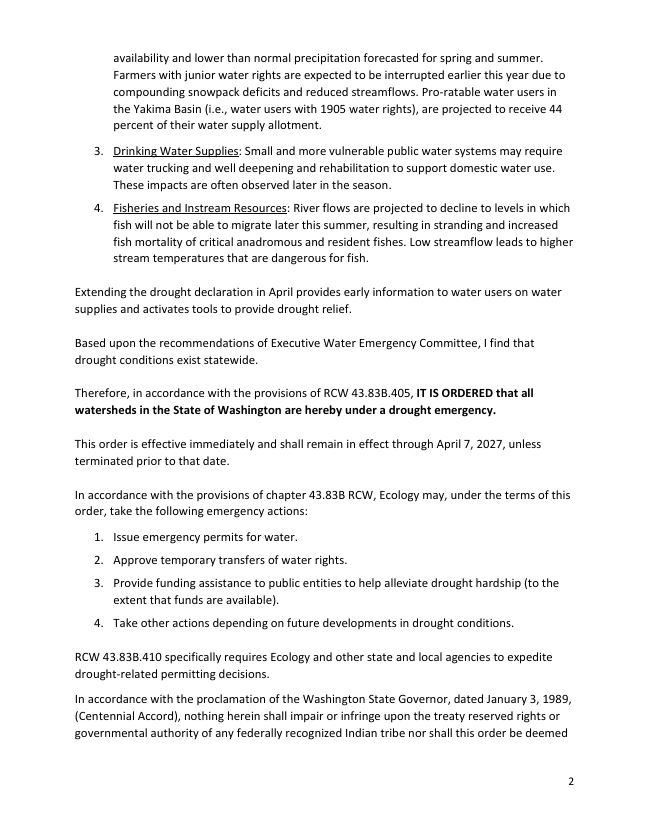
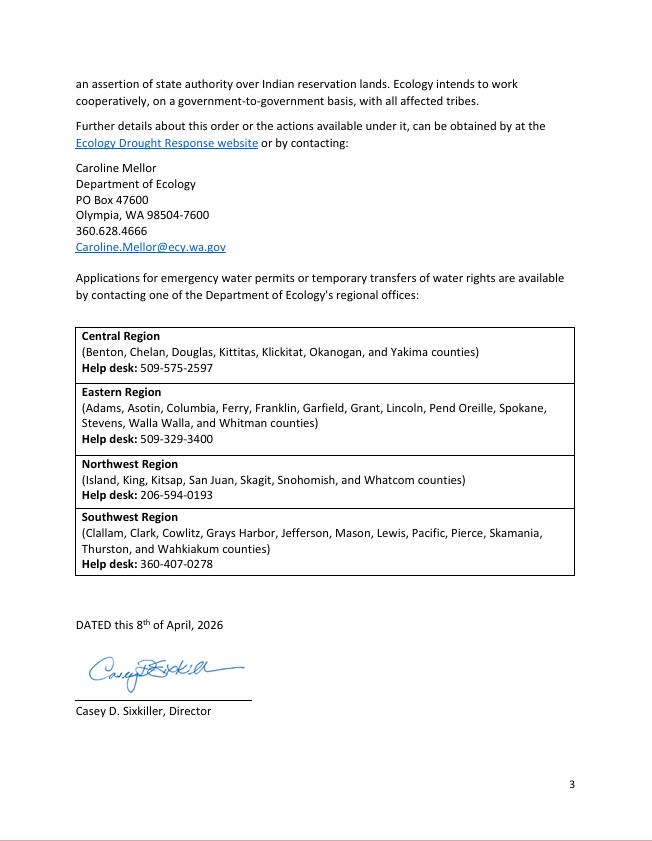
On April 8, 2026, Ecology issued a drought declaration for all watersheds in the state due to low snowpack and multiple years of precipitation deficits. This is the state’s fourth consecutive drought declaration – a record under the current drought framework established in 1989.
Drought emergency declared statewide
Ecology issued a statewide emergency drought declaration due to low snowpack and multiyear compounding deficits in precipitation, from the 2023, 2024, and 2025 droughts.
This year is an example of the impact of effects of snow drought, where we have normal precipitation over the year, but the warm winter led to increased rain and floods, with low snowpack all winter. Without enough snowpack to store water, we expect impacts on water supply.
In the water supply and drought context, “normal” refers to average water supply from the 1991-2020 period, for this day in history. This baseline is adjusted every decade.
A drought declaration serves as a statement on water supply. State law has two conditions that guide a drought declaration: (1) water supply below 75% of normal (average of the last 30-year period), statewide or in specific geographic areas, and (2) the water shortage will likely create undue hardship for water users or the environment.
We continue to monitor water supplies and encourage people to use water wisely.
A formal drought declaration allows us to provide emergency drought relief by:
- Expediting processes for Emergency Drought Permits.
- Processing temporary transfers of water rights.
- Provide funding assistance for public entities (municipalities, irrigation districts, PUDs, etc.).
Examples of how we’ve used funds in past droughts include:
- Processing emergency water right permits.
- Leasing water from irrigators growing annual crops for instream and out-of-stream uses.
- Funding emergency infrastructure for communities and irrigators.
- Resolving fish passage barriers.
Our water supply in the critical months of April to September is largely determined during winter. Snowpack serves as natural storage and warm temperatures or less precipitation in winter leads to less water available in summer and early fall when most needed.
On March 5, 2026, the U.S. Bureau of Reclamation issued an initial April-September estimate of the Total Water Supply Available (TWSA) for proratable water right holders of 44%. This is very low and concerning for agricultural and fish needs in the Yakima Basin.
TWSA reflects multiple water supply indicators, and the forecast affects the amount of water junior or proratable water users are entitled (i.e., water right holders with 1905 or later priority dates).
Snowpack is integral to water supplies in the Yakima Basin, regardless of reservoir level. Storage is only about 1-million-acre ft., while irrigation and fish demand is around 2.5-million-acre feet. Runoff from snowpack is needed to make up the missing 1.5-million-acre feet for April to September water supply.
Community impacts and support
The areas in the drought emergency area include key agriculture areas that are very dependent on streamflows and reservoir releases.
Pro-ratable water users in Yakima (i.e., water users with 1905 water rights), are forecast to receive 44% percent of their water supply. This drought declaration covers our state’s most important agricultural areas, with more than $3.5 billion in revenue. Roza Irrigation District alone produces approximately $1.5 billion amount in agricultural revenue.
Farmers with junior water rights in the Yakima Basin are expected to be interrupted earlier this year. Curtailment occurs when there is not enough water to supply all water rights. The most recently established rights are curtailed to protect prior established water rights. For example, a water right established in 1945 along a particular creek might have to be curtailed to protect a right established in 1905 along that same creek if there is not enough water to satisfy both the 1905 and 1945 rights.
Water users worried their water supply is at risk of failing should contact the nearest Department of Ecology Region Office.
A formal drought declaration allows us to provide emergency drought relief by:
- Expediting processes for Emergency Drought Permits.
- Processing temporary transfers of water rights.
- Access drought funding provided by the state Legislature.
This year will have $3 million in drought emergency response grant funds to support public entities for emergency projects related to drought. These funds are for emergency relief only to address water supply impacts from current drought conditions.
You can also help us monitor the drought by submitting observations and photographs to the Conditions Monitoring Observation System.
Climate projections
The warm winter, including our warmest December on record, led to historic flooding as precipitation that would otherwise be held in snowpack all came as rain instead. Meanwhile, the same precipitation was not stored in our snowpack and now, that water isn’t available to support our water supply when most needed this summer and early fall.
As climate change boosts winter temperatures, snowpack droughts are becoming a common feature of Washington winters. For example, in the 1990s, on average, these were occurring about one in every five years. Today they are happening about 40% of the time. This change is accelerating. By the 2050s, the same study projects that seven out of every 10 years will see snow droughts, on average.
Drought Advisory
A drought advisory may be issued ahead of a drought emergency when it appears that drought conditions may develop. Drought advisories seek to increase awareness and readiness of affected water users. A drought advisory may suggest steps, like reducing water use, to conserve water. This can help water users plan, prepare, and even reduce the impact of drought conditions.
Drought advisories are a process adopted in 2020. Drought advisories are informational only, and include no emergency authorizations or funding.
Laws and rules
- Chapter 43.83B RCW – Drought conditions
- Chapter 173-166 WAC – Emergency drought relief
- Chapter 173-167 (2025) WAC – Emergency drought funding
 Pierce Prairie Post