
By Chuck Haviland
Pierce County was formed out of Thurston County in 1852. It’s most notable for having the tallest mountain in the Cascade Mountain Range, Mt. Rainier. It was known to the Indians as Mt. Tahoma.
In Feburay 1854, the new legislature was called into place. Their first item of business was to grant George Bush and his heirs the land that they lived on. Michael T. Simmons and H. A. Goldsborough sold real estate and helped create much of Olympia. At that time, the town had a population of about 100 people.
During the Indian Wars of 1855 – 1856 McAllister was one of the very few men who lost their lives. Lewis Nesqually Bush recounts those events. He wrote :
“I was born on the homestead after the folks reached Bush Prairie, so I cannot remember as well as my brothers about the Indian War. I know we were all anxious and worried for several months and when the first scare was on my father moved his family to the Fort at Tumwater for awhile. But as time went on, he was anxious to get back to his place, as were the other settlers of our neighborhood, so they went to work and built a fort of their own on his father’s land. It was known as Bush’s Fort. “
In Dec 1854 the Indians signed the medicine creek treaty. This was done by what is known as the Treaty Trees. These trees have survived throughout the decades alongside of I-5 in Thurston County. 
William Owen Bush was born in Missouri and came westward with his family. He moved to the Grand Mound area of Washington State. The first of his many agricultural awards was in 1875. He went on to become known as one of Washington States most famous farmers. Some of his awards were in 1875, at the Philadelphia Centennial exhibition. While his awards toured the United States his exhibit was put on display at the Smithsonian Institution. In the 1880 federal census report William Bush was listed with his wife Amanda (Mandane) and eight children. They are Napoleon age 21 (in 1880), George W. age 18, Albert A. age 13, Robert O. age 10, Martin L age 6, Hiram L age 4, Ada Ann age 3 and Sarah. He was elected to the Washington Territorial Legislature in 1889. Jack and Owen were the only two sons to ever marry.
William Owen Bush was the eldest son of George and Isabella Bush. George Bush was a mixed-race settler who came with his large family to what is now the Tumwater, Washington area in 1845. The Bushes and their sons, William Owen, Joseph Tolbert, Rial Bailey, Henry Sanford, January Jackson and Lewis Nesqually were all farmers on the 800 acre Bush farm along the Deschutes River.
William Owen became one of Washington’s most famous farmers. He was born in Missouri in 1832 and came west with his parents. After a trip to the California Gold Rush in 1850 he moved to the Mound Prairie south of Tumwater with his wife Mandana Smith Kimsey Bush. After his parents’ deaths, he moved to the Bush Prairie farm and with his wife and brothers, helped organize the Western Washington Industrial Association (WWIA) in 1872 to promote agricultural exhibitions.
The first of his many agricultural awards was in 1875 which prompted the territory to authorize his exhibit at the Philadelphia Centennial Exposition in 1876. There he won bronze medals and certificates for the “best wheat in the world.” The exhibit was put on permanent display at the Smithsonian Institution while the medal and certificates were proudly shown from community to community around the territory.
In 1889 William Owen Bush represented Thurston County in the first state legistlature.
In 1841 the US government permitted the pre-emption claims. These areas were essentially squatters rights to 160 acres. Many families took advantage of this and started to settle North of the Columbia river. In 1845, 32 settlers came to what is now known as Tumwater. This was the first real large settlement in the Northwest. Tumwater quickly built a flour mill, a sawmill, a shingle mill and a brick plant. Measles and cholera took a devastating effect on the local Indian population. All of these actions prompted the early settlement of Puget Sound.
In 1848 Puget Sound had very few settlers. Most of them lived at three locations: Tumwater, Fort Nisqually and the Cowlitz farm area, near present day Toledo.
In 1850 the Oregon Donation Land Claim Act was passed by congress. This act permitted a husband and wife to claim 640 acres.
Nicolas Delin built a water powered sawmill at commencement Bay in 1852. By the end of the year the mill was processing timber into lumber that was sold in the local markets and to California. Sam McCaw, Jacob Burnhardt and William Sales helped Delin build the sawmill. The logs were cut with an oscillating muley saw. This is recognized as the beginning of the lumber trade. Delin was described as a long-nosed, spade bearded Swede. In the first year he shipped 550,000 board feet of lumber to San Francisco.
Ezra Meeker was among the 1852 arrivals. Ezra Meeker first settled on McNeil Island in 1853. There was an abundance of building materials and the soils were good for farming. Yet it was remote, being three miles across the sound to the nearest town of Steilacoom. Their social life was nonexistent. After a year or so Ezra moved his family to Steilacoom and became a merchant. Ezra (1830 – 1928) went on to become a pioneer leader. He was also noted for being a successful farmer and merchant. With his wife Eliza Jane Sumner he founded the town of Puyallup.
Any discussion of Olympia’s beginnings would be incomplete without adding Leopold Schmidt a German immigrant. Schmidt contributed substantially to the employment of Olympia’s people with the establishment of his brewery.
August Jeschke worked for the Puget Sound Agricultural Company prior to settling on the prairie south of Muck Creek, in 1890. His neighbors were Henry Smith and Charles Wren. All three cemeteries are within a mile of each other (per USGS Quad maps). On the survey plat map filed by the Surveyor General in 1871, Henry Smith and Charles Wren can be easily found. Other neighbors that are noted on this map are: Michael Bustance, John Bradley, Jason Grant, C. l. Corica, George Brown, Thomas Vincent, Thomas Adean, Peter Wilson, S. McCaw, McMurray, J. McCloud and Hugh McCloud. The only ones that filed for a donation land claim were: Charles Wren DLC # 37, George Dean DLC # 39, Peter Wilson DLC # 38 Henry Murray DLC # 41, M.P. Clute DLC # 40, Henry Smith DLC # 42, John McPhail DLC # 43, and John McCloud DLC # 44. These donation land claims lie west of Muck Creek Cemetery (now known as Bethany Cemetery). Many of the early settlers were buried here.
Albert Jeschke was buried on the family homestead. Albert is probably the son of August Jeschke, who probably worked for the PSAC. An August and Bertha Jeschke are buried in the Spanaway Cemetery.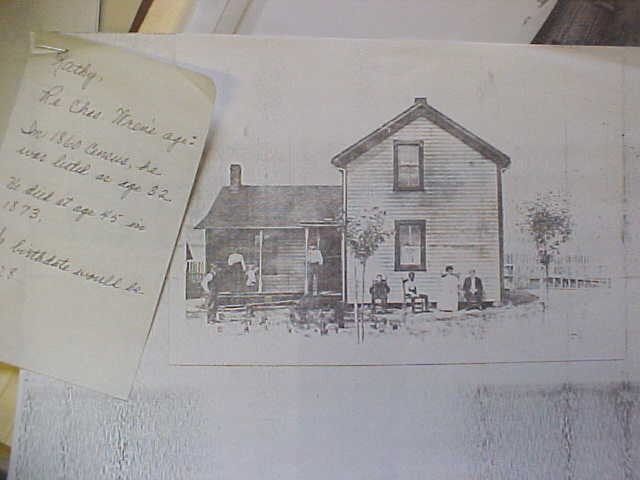
In 1849 Charles D. Wren also settled on the Muck Creek prairie. He became a successful cattle rancher. Charles Wren’s wife (Elizabeth) was the daughter of Charles George Ross, who established Fort Vancouver for the HBC. Wren filed for a donation land claim near Muck Creek Station.
During the Indian wars of 1855 – 1856, the military became suspicious of the local farmers who had taken Indians for their wives. Namely: Charles Wren, Henry (Lyon) Smith, John McCloud (McCleod), John McPhail, and Sandy Smith, were all charged with aiding and abetting the enemy (Indians), and giving them “victuals and ammunition”. These five men became known as the ‘Muck Creek Five’ and ‘King George’s Men’ by the Indians. Their defense was simple but ineffective, They claimed that the court had no jurisdiction for lack of a declared war. However, Judge Advocate Victor Monroe declared it a ‘constituted tribunal’, thereby permitting the military authority to act at the discretion of the Territorial Governor Stevens. The five were held at Camp Montgomery and on May 20, Sandy Smith actually went to trial. He was acquitted and the five were released.
Albert Henry Barnes was a great photographer. Many of his photographs are kept at the University of Washington in the Special Libraries section. Others are kept in the American Indian s of the Pacific Northwest. Because of his attention to detail in respect to the early pioneers, many of his photo’s are reproduced here.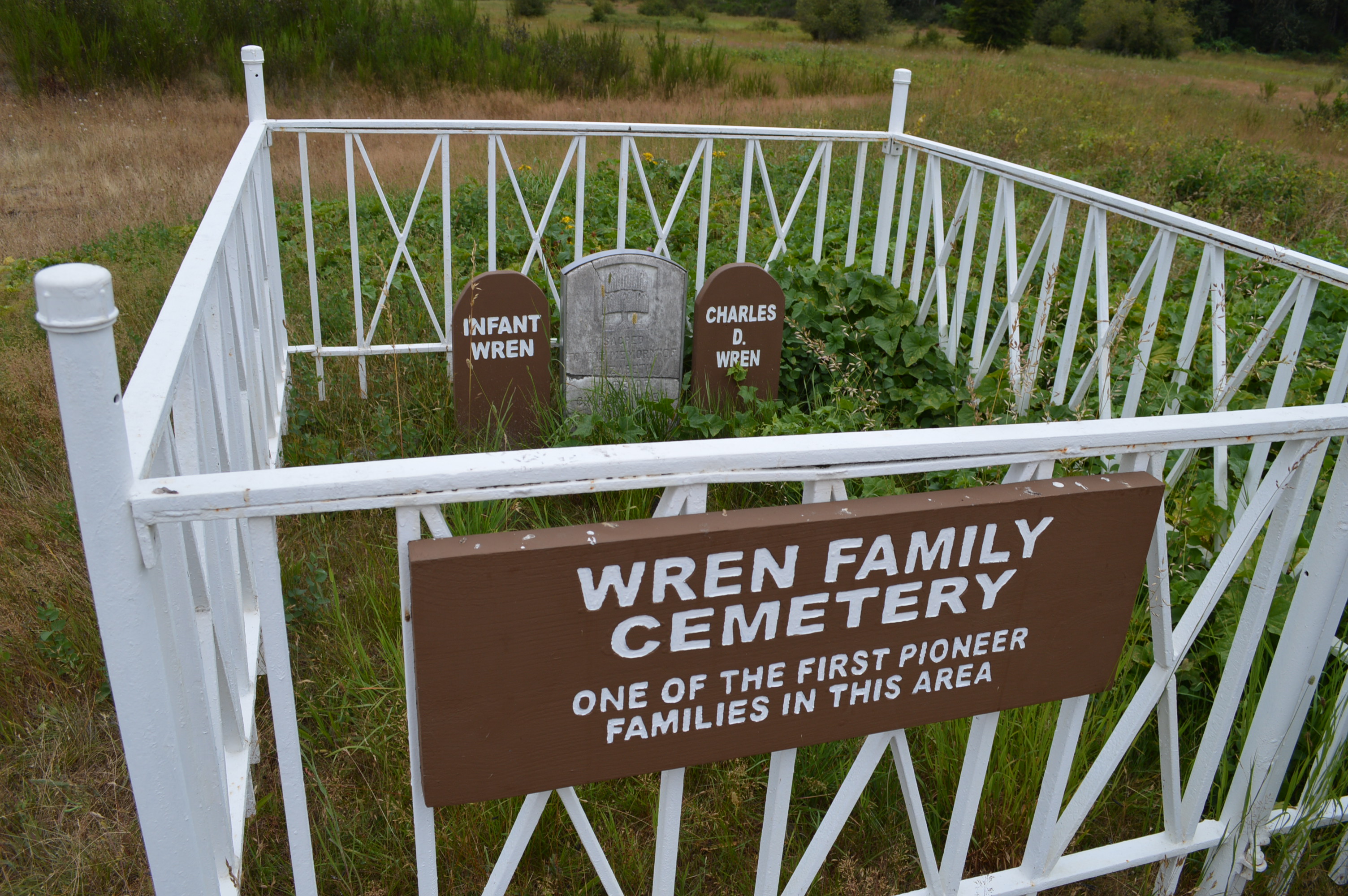
Charles Wren died in 1873, his farm was split between two daughters. Charles Wren was buried on his Donation Land Claim which is now part of the military base beside his wife Elizabeth who was buried with a stillborn son and an infant daughter.
The PIG WAR of 1859, was a war that never happened. The only casualty was a pig! As early as 1845 there had been a dispute between Great Britain and the United States as to who or where the boundary between the countries existed. The United States position was that as a result of the war of 1812 between the two countries that the 1818 treaty established he boundary as being to the middle of the channel, that is the Haro Straight. The English position was that the middle of the channel was to be the middle of Rosario Straight much farther east than the United States position. The crux of the whole matter was who controlled San Juan Island.
Two neighbors, Charles Griffin who worked for the HBC and Lyman Cutlar an American, on the island got into a dispute, because Griffins pig kept eating Cutlars potatoes. Cutlar had warned Griffin several times prior to shooting the pig. He attempted to compensate Griffin for the pig but Griffin wanted $100.00. This was too high a price for the pig and Cutlar refused to pay such an amount. When news of the dispute reached Washington DC, Brigadier General William Harney visited the Americans on San Juan Island. Harney was well known for his foul tongue and hot temper. At times he would bypass the chain of command to do as he pleased, in accomplishing his goals.
Harney assigned Captain George Pickett and Company D to the Island. This then prompted the English to send the British man-of-war Tribune. Captain Geoffrey Hornby of the Tribune asked Pickett to come aboard and discuss the matter. No agreement was reached between the two men at this time. The island remained under joint occupation until 1872 when it was deemed by the German Arbitrator to be American soil. All of that disagreement was over, a pig. No one else was hurt. The real dispute was over the boundary line between British Columbia and the United states. At issue was who controlled San Juan Island.
 Pierce Prairie Post
Henry (Lyon) Smith is simply Henry Smith. Sandy Smith is Lyon Alexander “Sandy” Smith