
By Marianne Lincoln
The following is the full written testimony I submitted to the Hearing’s Examiner for the City of Dupont as it considers the Pioneer Aggregates South Parcel Expansion Project. With 68 years of knowing Dupont and its history, I had several options of how to approach this topic.
Don Russell, 96, left me his tidy box full of notes, data, and letters about the area’s water. It is an incredible wealth of information and well documented. But the ancestors insisted on inspiring me to write something different that not many others could write.
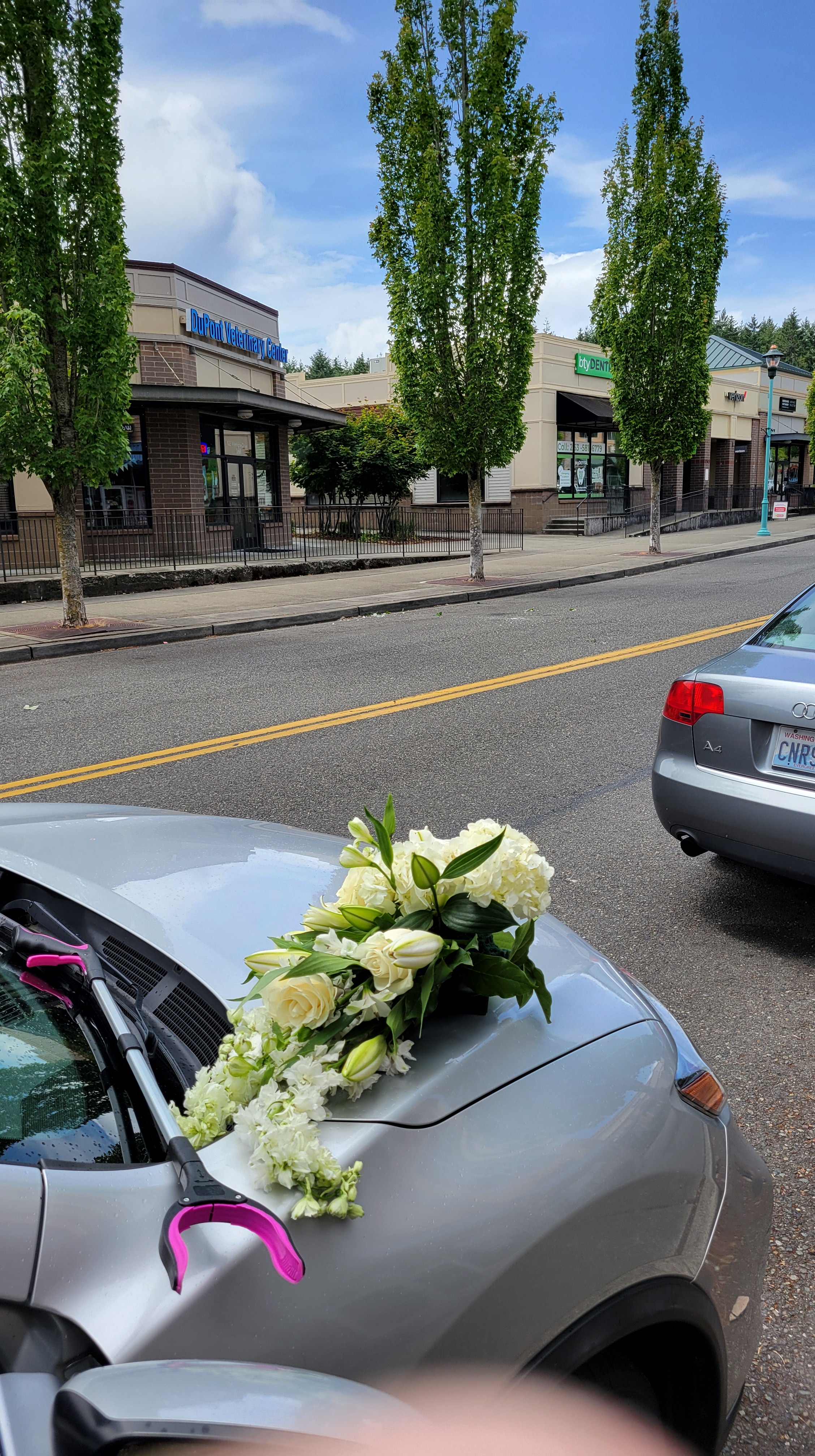
In fact, I was only going to submit the article and my ghost photos by email, but at lunch, they tripped me on my own statements, as I warned they would. There, in the middle of busy Wilmington Drive, was a bouquet of beautiful white roses, lilies, and stock, broken on the street. Cars were going around it. I stopped, picked it up and brought it to the hearing. I was sitting next to the Nisqually Tribal members. When I finished, one of their lawyers had tears in her eyes, held my hand, and thanked me. They knew that was for them, living and past.
Here is the letter:
As a supporter of water in creeks, fish habitat, water to drink for a quickily growing population in a sole source aquifer, and a person who is aware there have been aquifer busting accidents on more than one occasion in Washington State by gravel operations (Cadman/Monroe for instance) I oppose the dewatering of an aquifer to mine gravel in this location. I am not opposed to mining the gravel, but I am opposed to breaking into and dewatering the aquifer.
My testimony will not be exactly what is expected of someone who is on the boards of several water related organizations and has a degree in chemistry and experience testing water. No, because in addition to those, I grew up friends with a dowser and sensitive to the interaction of water and the human energy surrounding me.
In 2004, I became the historian for the Descendants of Fort Nisqually Employees Association that met here in Dupont for many years. Descendants of the Kittson’s, McPhail’s, McLeod’s, Rosses, Byrd’s, Smiths, Chief Scanewa, Satiacums, Chalifaux and others were part of this group during my membership. I also grew up with descendants of Benstons, Chambers, Meyers, and Rice’s.
You see, I did not become the historian for DFNEA just because I had done a significant amount of research on Fort Nisqually, the families, and the Methodist Mission. I grew up in areas where those employees lived and went to school with their descendants. I walked in the tidelands of the Nisqually Reach and played with the salmon fry in the lagoon at Hogum Bay as a child. Each time my family drove past the fort sites, the Treaty Tree, and the Dupont Powder works, I heard stories from my mother about them all. I strolled through the woods where these people lived, even with their houses gone, I photographed the sites. I have a computer file titled ghosts, because as anyone who ever photographed the Aurora Borealis knows, the camera picks up magnetics difficult to see with the naked eye.
I became the historian because I was called to be there. I was not a descendant, but I listened to them all, those living and those who called from the past. Look over here and take a photo there. My truck broke down on a road to the Mashel Massacre site, just in time to meet the owner of the Nisqually Trail property at her mailbox. Coincidences? It doesn’t seem like it when they happen time after time.
The City of Dupont sits on a crossroad of history. It isn’t just a plot of land with a fence and a stylish historical sign. It is a living, breathing anomaly in time from when the natives of the past began to interact with the visitors from far away who bought livestock, tools, weapons, knowledge, and, sadly, diseases with them. The souls of that past still inhabit this place. They called to me my entire childhood, until I could finally actually access this site. They helped me rent a kayak on Christmas Day 2004, on the 150th anniversary of the Medicine Creek Treaty and survive the paddle down McAllister Creek in the rain. It was only 15 days after Leschi’s Exoneration Trial, which I had attended. The Treaty Tree fell in a windstorm two years later on December 15. Billy Frank Jr. was photographed cradling the fallen monarch.
You may steal the water from the creek. You may prevent the salmon from spawning in the waters of the Sequalitchew. You may try to hide the historical record and remains of places that were here by plowing, grading and building concrete mega warehouses on top of them. But you will never be able to prevent the energy leftover from those lives from existing in this place.
I have a box of statistics, notes, comments, research and poignant data from Don Russel. I have history from my mother who testified in past years to stop the deep-water port in the Nisqually Reach. I have stories of the battles and offers of developers who approached Ken Braget from visits with him.
Dupont is not just a little city wedged between a military base and Puget Sound. The inception of Dupont touched all of Pierce County, Washington State Territorial history, and the navigation of Puget Sound to the Cowlitz and Columbia Rivers. In their records and journals, its early residents recorded the lives of Native American families, the trails over the Cascades, the routes through the state waterways, and married into Indian families who settled the land and are today still prominent in local tribes to this day.
Dupont may be bustling today with houses, businesses, families and pets, but it will always be at the epicenter of a profound local historical spiritual force that will not stay unseen.
Doctor Tolmie always warned settlers not to disturb the north side Sequalitchew Creek because of that profound ancient spiritual force. And I leave you today with that same warning. Not in numbers, statistics, research, or environmental law, but in knowledge that there really is something to these places to which thousands of years of human existence have learn to pay heed.
MCTreatyTree.avi https://www.youtube.com/watch?v=AfW4PBPQFQg&t=10s
Marianne Lincoln
Affiliations:
Historian, Descendants of Fort Nisqually Employees Association
Miller Family Hogum Bay Property, Nisqually Land Trust
Chamber Clover Watershed Council
Clover Creek Restoration Alliance
Spanaway Community Association | PiercePrariePost.com
Past employee of Washington Rock Quarries
° ° ° ° ° ° ° ° ° ° ° ° ° ° °
These are random anomalies, ghosts my camera picked up at Wilkes Observatory and in the southeast corner of the mine’s south parcel near the Methodist Mission site. I did outline the Chloe Clark ghost because you cannot zoom in on it well enough here. The statue from the elementary school was not int he testimony I included it here for context. The flowers are the ones I found and placed in the hearing room on a red blanket.



 Pierce Prairie Post
I like it Marianne. Nice job expressing what this whole property means; it’s spirit, it’s environment, it’s history.